Technology

What sets us apart

A closer look at the engineering behind our flight computers, telemetry, and connected workflow.

01 · State estimation

A flight computer that understands the flight

A rocket does not experience one steady environment. It sits motionless on the pad, accelerates violently through boost, crosses into coast, reaches apogee, and then swings beneath its parachutes. Vega does more than record those measurements: it continuously determines which part of the flight is happening and adapts its decisions accordingly.

Its state estimator runs 100 times per second. A Kalman filter combines fast accelerometer measurements with barometric altitude to estimate height above the launch site, vertical velocity, and accelerometer bias. During boost it reduces its trust in pressure measurements disturbed by airflow and transonic effects; during coast it gradually brings the barometer back into the calculation; under parachute it stops relying on misleading vertical acceleration.

Critical events are based on stable trends preventing anomalous sample from interfering with expected behavior. Sensor spikes are filtered before estimation, and conditions such as apogee or main deployment must remain valid before Vega acts.

Drag to zoom · Double-click to reset
EuRoC '23 · ÆSIR Signý · first 10 secondsView flight ↗
02 · Telemetry

Telemetry made for a crowded launch field

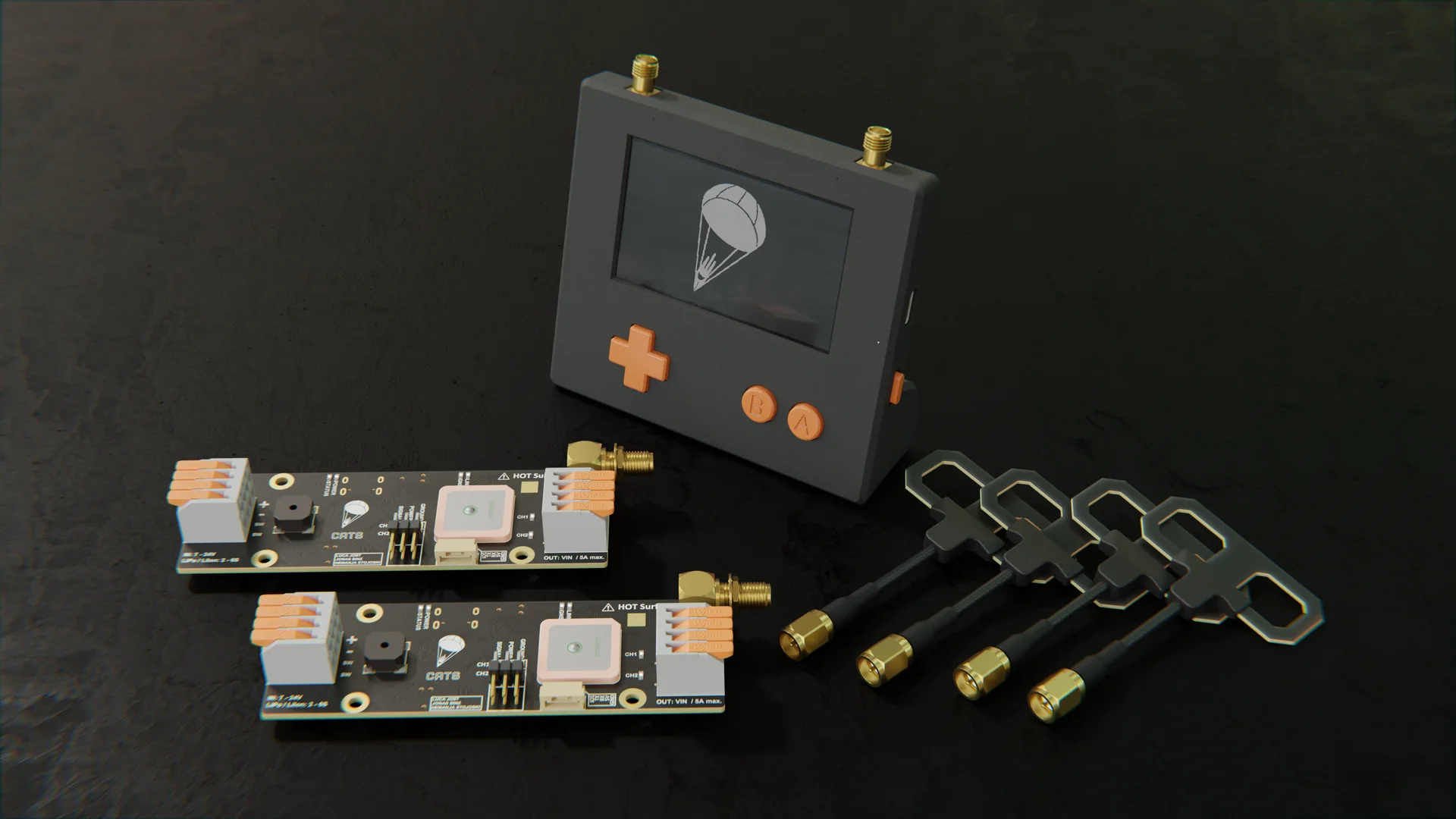
Live telemetry should remain dependable even when the launch site is full of teams, rockets, radios, and ground equipment. CATS combines long-range 2.4 GHz LoRa telemetry with Frequency-Hopping Spread Spectrum, continuously moving each connection through a repeating sequence of frequencies instead of occupying one fixed channel.

Every link phrase produces its own hopping pattern. That allows many independent CATS systems to operate in the same field without requiring coordination or reserved channels. If two transmissions briefly meet on one frequency, they move on again instead of remaining locked in persistent interference.

Vega sends its latest flight state, altitude, velocity, GNSS position, system health, and recovery information to the Ground Station ten times per second. The link has been flight tested beyond 10 kilometers at 100 mW, giving you immediate awareness during flight and the last known position they need when recovery begins.

CATS Ground Station with two Vega flight computers and antennas
Independent links, built to share a busy launch field.
03 · Connected workflow

One connected system, from setup to insight

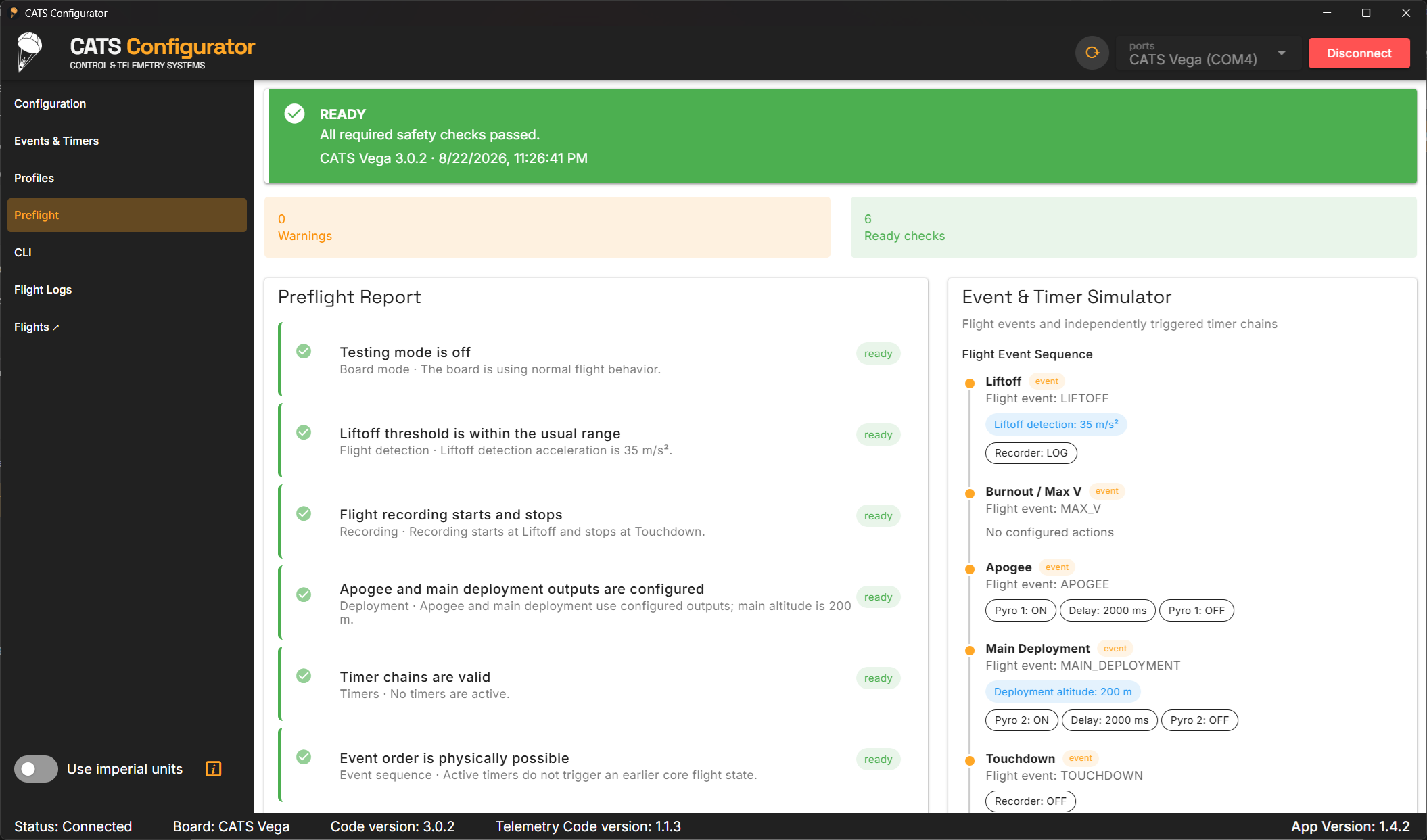
From configuration to recovery, every part of the CATS system is designed to work together. Before launch, CATS Configurator connects directly to Vega so recovery events, outputs, timers, telemetry, and flight settings can be prepared in one place. Preflight checks then turn that configuration into a clear, reviewable flight sequence.

During flight, Vega controls the mission, stores a high-rate onboard record, and sends the essential live information to the Ground Station. The same flight states used by the estimator drive recovery actions, appear in telemetry, and remain attached to the recorded data. What happens onboard and what you see on the ground are parts of the same system.

After recovery, the logs can be opened directly in the Configurator or CATS Flights for interactive plots, event review, GNSS replay, sharing, and deeper analysis. Because the hardware, firmware, and applications are open source, you can inspect how the complete chain works: from the first sensor reading to the final flight report.

CATS Configurator preflight report and flight sequence
One reviewable sequence before, during, and after flight.

Explore the system

See how the technology comes together.